
What to ask a heat pump installer: essential checklist
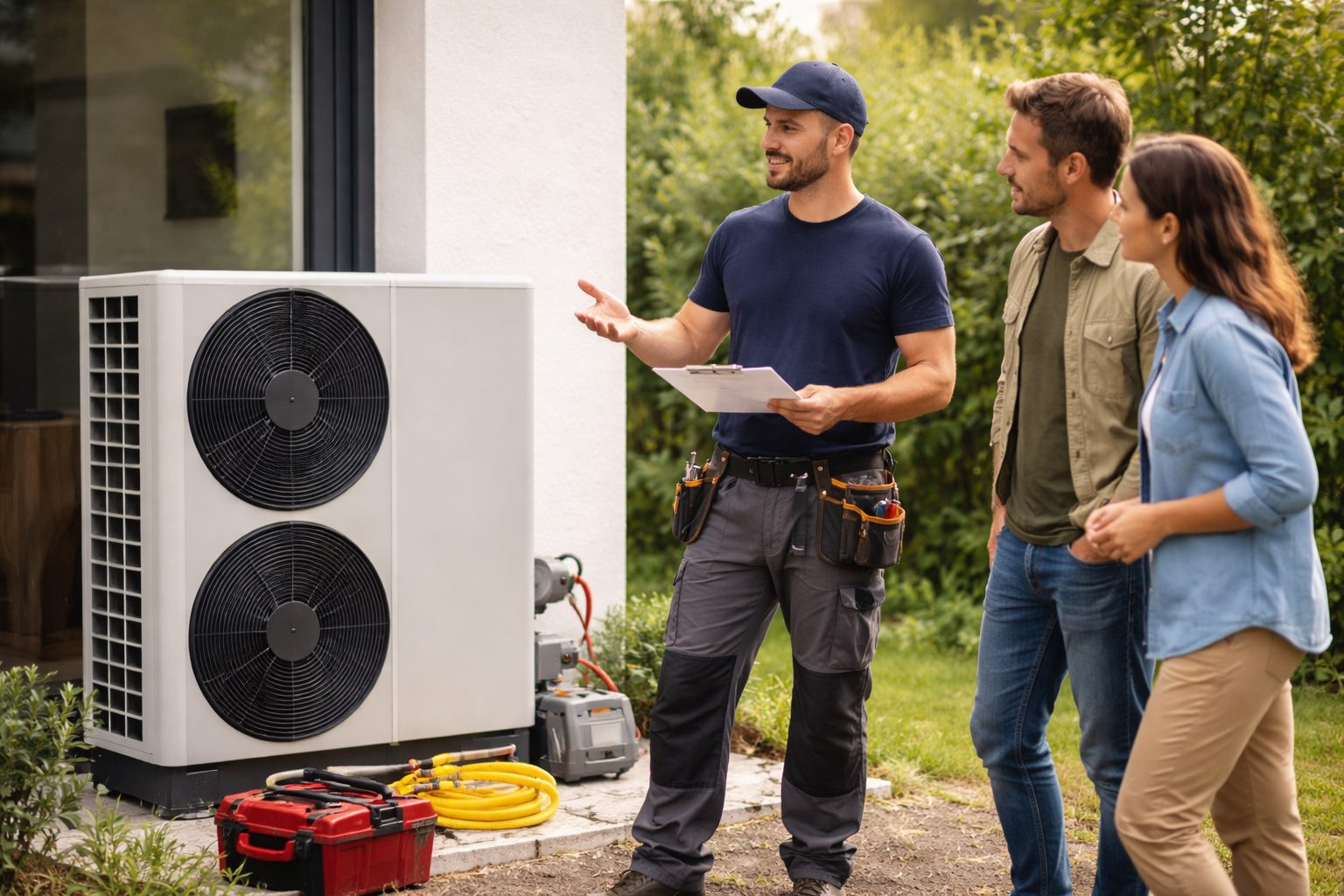
Choosing the right installer saves time, money and disappointment. Ask targeted questions about sizing, performance, costs and guarantees before you sign any contract.
Start by checking the installer’s experience with the specific heat pump type you want, whether air-source, ground-source or air-to-air. Confirm expected running costs, installation times and what guarantees and aftercare are included.
1. Installer credentials and experience
Don’t accept a generic answer such as “we do heat pumps”. Probe for specific credentials, practical experience and evidence of competence.
- Ask how many installations of this specific heat pump type they have completed in the last 12–24 months.
- Request references or photos from recent jobs, and follow up with the customers if you can.
- Confirm whether the installer is registered with relevant industry bodies and whether they can sign off any required compliance paperwork.
- Check if the installer carries suitable insurance for both liability and workmanship.
2. Sizing, survey and proposed system
Proper sizing is crucial: an oversized unit cycles inefficiently, while an undersized one won’t meet your needs. A competent installer will propose a system only after a full survey.
- Ask for a copy of the heat loss calculation or survey that justifies the system size.
- Discuss where external units will be positioned, noise levels and access for maintenance.
- If you’re considering a specific technology, ask whether they install that type regularly — for example, air-source systems or ground loops for a ground source heat pump.
- For homes that rely on radiators, ask whether radiators will need upgrading or whether a low-temperature distribution such as underfloor heating is recommended.
3. Costs, timescales and what affects them
Get clear, written cost estimates that separate equipment, installation labour and any additional work (electrics, pipework, groundworks). Ask how long the install will take and what might extend that period.
Typical price and timescale ranges are shown below; actual costs depend strongly on property size, complexity and the chosen technology.
| Work | Typical range (£) | Typical duration | What makes the price/time vary |
|---|---|---|---|
| Air-source heat pump installation (detached or larger property) | 7,000 to 18,000 | 2 to 5 days | Property size, need to upgrade radiators/electrics, outdoor unit siting |
| Ground-source heat pump (including groundworks) | 15,000 to 35,000 | 1 to 3 weeks | Type of ground loop, excavation works, access to garden |
| Air-to-air heat pump installation (single unit) | 2,500 to 6,500 | 1 to 2 days | Number of indoor units, wall works, controls |
| Upgrading distribution (radiators or underfloor) | 1,000 to 10,000 | 1 day to several weeks | Extent of work, need for new pumps, floor finishes |
Factors that commonly increase cost or duration include replacing or upgrading the existing boiler or controls, requiring additional electrical work, installing a hot water cylinder, or difficult access for groundworks. If you want an air-source unit, speak to an installer who understands how to optimise performance; some specialise in air source heat pumps.
4. Performance, running costs and controls
Ask for realistic expectations of seasonal performance rather than impressive peak figures. The installer should explain how the heat pump will meet your hot-water demands and how it interacts with existing heating controls.
- Request an estimate of seasonal performance and how that translates into running costs for your property (presented as a range).
- Ask whether you’ll need a new cylinder, buffer tank or immersion heater and how the control strategy will be set up.
- Clarify who supplies and sets up smart controls, remote monitoring or weather compensation, and whether they are included in the quoted price.
- If you’re considering an air-to-air option, discuss the number and placement of units; an installer experienced with air-to-air heat pumps can advise on zoning and efficiency.
Get up to 3 quotes from heat pump installers
Describe your project in a minute. Free, quick and with no obligation.
Request your quote through our platform
Our platform lists 42,621 heating engineers in 1,357 towns.
Compare local firms and get several quotes from a single request — free and with no obligation.
Get a quick quote
- Free and no obligation
- Quotes from installers who cover your area
- Check what grant your installer can claim
- You choose who to hire, if anyone
Thank you — we have received your request!
A local firm will contact you as soon as possible about your free, no-obligation quote.
5. Guarantees, aftercare and incentives
Get written details of warranties for both the equipment and the installation work, including what is and isn’t covered, and for how long. Ask about emergency call-outs and routine maintenance requirements.
- Find out what parts and labour are covered by the manufacturer and what the installer’s own warranty covers.
- Ask whether maintenance contracts are offered and what a typical service includes.
- Inquire whether the installer can help with paperwork for any available support; for guidance on available schemes, see heat pump grants and official guidance.
Frequently asked questions
How long does a typical heat pump install take?
It varies by system: a single air-to-air unit can take a day or two, a full air-source swap commonly takes 2–5 days, while ground-source installs that need excavation may take one to several weeks.
Will my radiators need replacing?
Not always. Some properties will work with existing radiators, but many need larger radiators or low-temperature distribution like underfloor heating to get the best efficiency and comfort.
What ongoing maintenance is required?
Heat pumps generally need an annual service to check refrigerant levels, controls and circulation pumps; more frequent checks may be advised for systems with complex groundworks or multiple zones.
Conclusion
Before you decide, get at least three written quotes that include surveys, sizing data, all foreseeable extras and warranty terms — then compare them line by line. If you’re considering which technology suits your home, an installer experienced with different systems can compare options such as air-source or ground-source solutions to find the best match.